
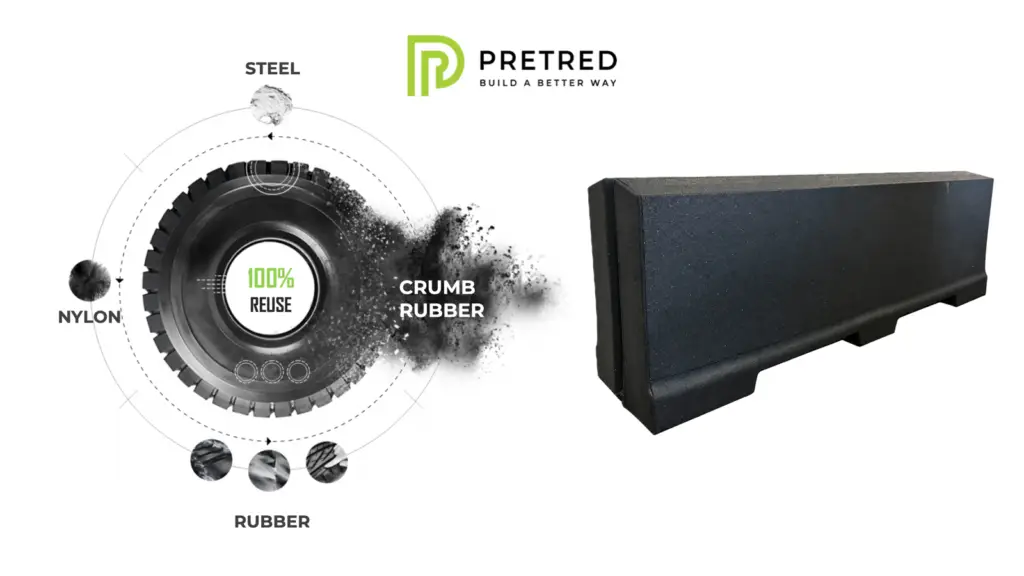
What happens when a tire reaches the end of the road? Through circular manufacturing, its materials can become the starting point for something new.
Pretred’s system transforms end-of-life tires into durable, recycled rubber barriers. It recovers tire materials for further use and creates barriers that can eventually be recycled into new barriers. That connects tire recycling, manufacturing and infrastructure within a system designed to keep materials in circulation.
What is circular manufacturing?
Circular manufacturing is an approach to making products that keeps materials in use through recovery, reuse and recycling. It considers both where manufacturing materials come from and what can happen to a product after its useful life.
For infrastructure buyers, that creates two useful questions: Does a product use recovered materials? And is there a pathway to recover those materials again?
Pretred’s system addresses both.
How does Pretred’s circular manufacturing system work?

1. Start with end-of-life tires
Used tires enter Pretred’s processing stream as a manufacturing resource. This gives discarded material a new purpose in infrastructure.
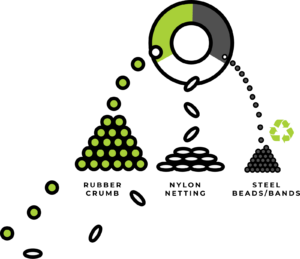
2. Recover the different materials
Tires contain rubber, steel and fibers. Pretred separates these components: rubber becomes crumb for barrier manufacturing, while steel and nylon fibers are recovered for other uses.
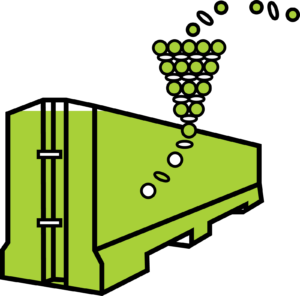
3. Manufacture recycled rubber barriers
Pretred transforms recovered rubber into barriers made with approximately 95% recycled material. The result is a practical application for tire-derived material in infrastructure.
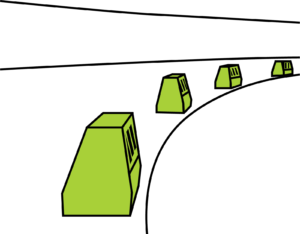
4. Keep the material available for another cycle
Pretred barriers can be recycled into new barriers. Customers can review Pretred’s FAQ for information about take-back and end-of-life material programs, then contact the team to discuss arrangements.
What does research say about tire recycling?
Research helps explain why material recovery belongs in a circular manufacturing strategy. A life cycle assessment of waste tires recycled into crumb rubber evaluated the process of turning discarded tires into a material used to modify asphalt, including the role of energy sources in recycling.
A separate study of end-of-life tire management in Colombia found that recovering materials such as rubber and steel could provide climate benefits by replacing materials that would otherwise need to be produced. Together, these studies support evaluating material recovery as part of circular manufacturing, while showing why the process and application matter.
These studies examine tire-recycling applications and scenarios; Pretred-specific environmental comparisons require product-specific life cycle data.
Why does circular manufacturing matter for infrastructure?
Infrastructure purchasing decisions shape demand for materials. Choosing products made with recovered resources creates a market for those resources and gives recycling a practical destination.
Circular manufacturing also encourages buyers to look beyond the initial purchase. Material sourcing, product use and end-of-life planning become part of the same conversation.
For contractors, municipalities and project owners, useful questions include:
- What percentage of the product comes from recycled material?
- Does the product meet the requirements of its intended application?
- What happens when the product needs to be replaced?
- Who handles collection and material recovery?
These questions help translate circular economy goals into purchasing decisions.
Where does Pretred’s circular manufacturing system show up?
Pretred’s rubber barrier product range connects recovered tire materials with different infrastructure needs:
- Standard Pretred Rubber Barrier: a versatile option for site and perimeter applications.
- TL-2 Rubber Barrier: designed for lower-speed roadway and work-zone applications.
- Load-Rated Rubber Barrier: engineered for heavy-duty load-support applications.
- Paceline Bike Lane Barriers: physical separation for protected bike lanes.
Review the individual product specifications and barrier FAQs to help identify the appropriate option for your application.
Connecting tire recycling to circular infrastructure
Pretred connects a waste stream with a manufacturing application: end-of-life tires become material for infrastructure, and the resulting barriers have a pathway back into production.
That is circular manufacturing in practice, planning for material value across more than one product life.
Explore Pretred’s circular manufacturing system or contact our team to discuss recycled rubber barriers for your project.
Frequently asked questions
What makes the Pretred system circular?
Pretred uses recovered tire materials to manufacture rubber barriers that can be recycled into new barriers, connecting material recovery with future production.
What are Pretred barriers made from?
Pretred barriers are made with approximately 95% recycled material, using rubber recovered from end-of-life tires.
Can Pretred barriers be recycled?
Yes. Pretred barriers can be recycled into new barriers. Contact Pretred to discuss take-back arrangements and end-of-life program details.