
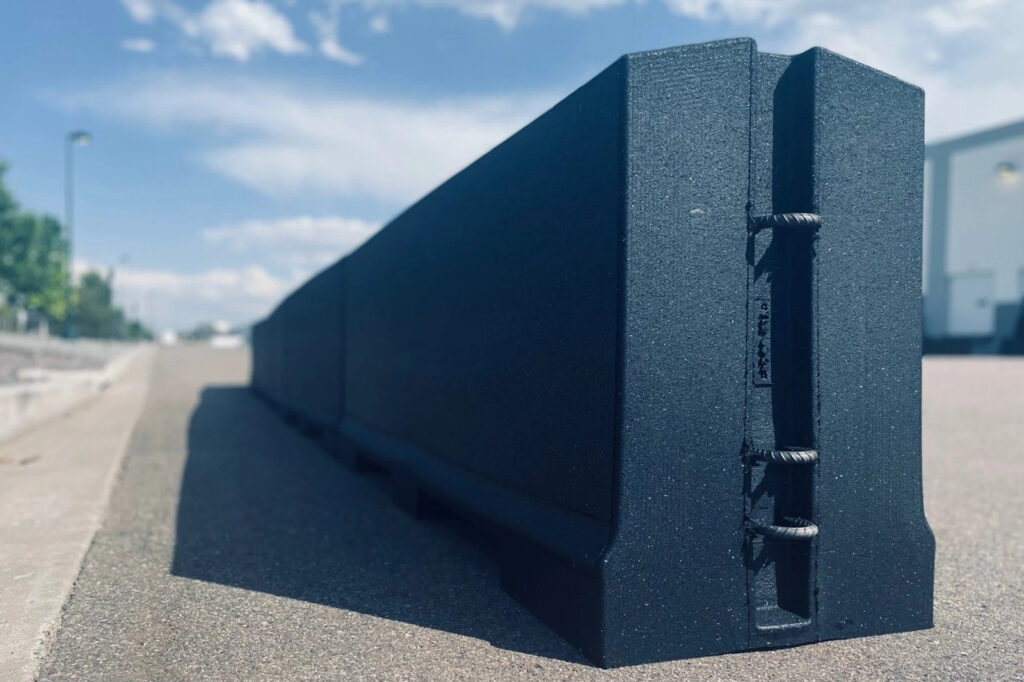
For teams searching for concrete barrier alternatives, recycled rubber barriers offer a strong combination of durability, easier handling and sustainability. Their lower weight can simplify transportation and installation, while the material itself is built to withstand impact and repeated use.
Concrete vs. Rubber Barriers
Material choice affects transportation, installation, maintenance, relocation and reuse. Those factors can influence project logistics, equipment needs, labor and long-term cost.
 Pretred Rubber Barriers |
 Concrete Construction Barriers |
|
|---|---|---|
| Weight | 2,100 lbs per 8 ft barrier More than 30% lighter |
3,000–4,000 lbs per 8 ft barrier |
| Transport | Up to 22 barriers per truck Up to 28 per truckload for 6 ft barriers 33% more per truck |
Only 10–12 barriers per truck Fewer barriers per truck means higher shipping costs |
| Easy to Move | Move with any skid steer 2,100 lbs fits within a 2,700 lb limit |
Too heavy for most skid steers 4,000 lbs exceeds most lift capacity |
| Maintenance | Won’t crack Won’t break Lower maintenance cost |
Chips Cracks Ongoing repair |
| Impact Behavior | Energy-absorbing Reduces damage to vehicles |
Rigid Transfers energy to vehicle |
| Carbon Footprint | Negative carbon footprint 283% lower greenhouse gas impact than concrete |
Cement production accounts for roughly 8% of global CO₂ emissions |
| End of Life | Fully circular Ground down and remade into new barriers |
Landfill or incineration Debris, burning or low-value disposal |
Every Pretred barrier saves 70–250 tires from landfill or incineration.
Weight and Transportation
Concrete barriers are heavy by design. Moving and placing them can require multiple trucks, large equipment and additional labor, especially on projects where barriers need to be relocated as traffic patterns or work zones change.
Rubber barriers are lighter, which can simplify transportation, placement and repositioning. Depending on the application, that can also reduce equipment requirements and make barrier moves easier to manage.
Durability and Impact Performance
Concrete can chip, crack and deteriorate over time, particularly after repeated impacts or movement. Rubber responds differently to impact and can absorb force without developing the same type of cracking.
That can be especially useful on projects where barriers are moved frequently or expected to remain in service for years. Longer service life can also reduce replacement frequency and associated costs.
Turning Waste Tires Into Infrastructure
Pretred manufactures barriers using recycled waste tires, creating a productive use for a material that is difficult to manage and dispose of.
Using recycled tire material also reduces the need for virgin materials and helps keep tires out of landfills and stockpiles. Pretred’s barriers are designed for transportation, construction and infrastructure applications where durability and long-term use matter.
End-of-Life Considerations
Barrier selection should also account for what happens when a product reaches the end of its service life. Concrete may be crushed, disposed of or downcycled depending on its condition and available recycling options.
Pretred’s manufacturing model is built around reuse and circularity, with a focus on keeping material in productive use for as long as possible.
Are Rubber Barriers a Replacement for Concrete?
Yes, but the right barrier depends on the application, required safety standards, testing requirements and project specifications.
Concrete remains appropriate for many uses. Recycled rubber barriers can be a strong option for projects where transportation, relocation, durability, reuse and sustainability are key considerations.
What to Consider When Choosing a Barrier
When comparing concrete barrier alternatives, consider the full project requirements, including transportation, installation equipment, relocation frequency, expected service life, maintenance and end-of-life planning.
Evaluating those factors together can help project teams choose the barrier system that best fits the application.
Pretred Barrier Options
Pretred manufactures several recycled rubber barrier systems for different roadway, construction, industrial and active transportation applications. All are made with recycled rubber and designed for durability, easier handling and long-term use.
Standard Pretred Rubber Barrier
The Standard Pretred Rubber Barrier is available in 6-foot and 8-foot sizes and can be used for construction zones, parking areas, pedestrian delineation, perimeter control, erosion control and other site applications. It is made from 95% recycled rubber and is available with options including reflectors, safety jackets, fencing and connection ends.
TL-2 Colorado Rubber Barrier™
The TL-2 Rubber Barrier, also known as the Colorado Rubber Barrier™, is an 8-foot MASH-compliant barrier designed for lower-speed roadways and work zones, including city streets, frontage roads and ramps.
Load-Rated Rubber Barrier
The Load-Rated Rubber Barrier is designed for heavy-duty construction and industrial sites. The 6-foot version supports loads up to 25,000 pounds, while the 8-foot version is rated for loads up to 32,000 pounds per barrier.
Paceline Bike Lane Barrier
The Paceline Bike Lane Barrier creates physical separation between cyclists and vehicle traffic. Its compact, interlocking design is built for protected bike lanes and other applications where visibility, protection and easier deployment are priorities.
TL-3 Rubber Barrier
Pretred’s TL-3 Rubber Barrier is currently coming soon. The 12-foot barrier is being developed for roadway applications requiring TL-3 performance.
Different projects call for different barrier configurations. View all Pretred barrier products or contact Pretred to determine which system fits your application.
Choosing the Right Barrier for the Job
Concrete barriers remain widely used, but recycled rubber gives contractors, municipalities and transportation agencies another proven material option.
Pretred uses recycled tire material to manufacture durable barrier systems designed for real-world infrastructure needs, while also helping reduce waste and extend the useful life of existing materials.